These records are found in the online catalog of The Mariners’ Museum and Park in Newport News, Virginia. Uncurated search results are presented to give researchers and interested readers an idea of whether the museum’s archives contain information about this vessel and whether it may be worthwhile to visit the museum’s catalog search page for further investigation. Uncurated results may be inaccurate or incomplete.
Mariners Museum online catalog search, July 12, 2026. Search phrase: "Henry B". Catalog returned 68 records; this selection table includes 68 records fetched through catalog result pages.
Use these buttons to send uncurated search results to your own app or text document for further research. First, check the box for any row, or click "Select All" then uncheck any rows. Then click "Show Selections". You can then copy your selections from the text box and past them into your app.
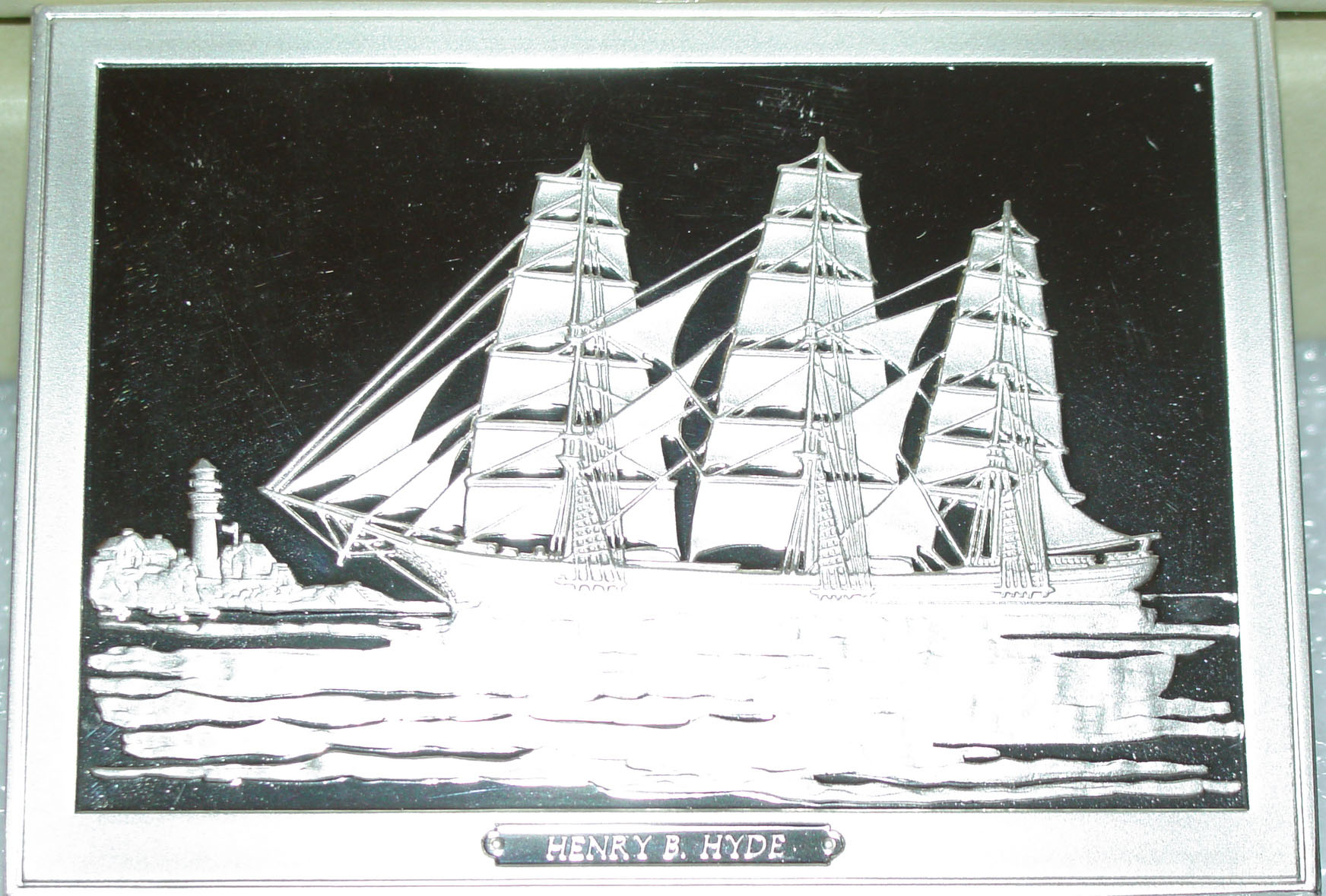
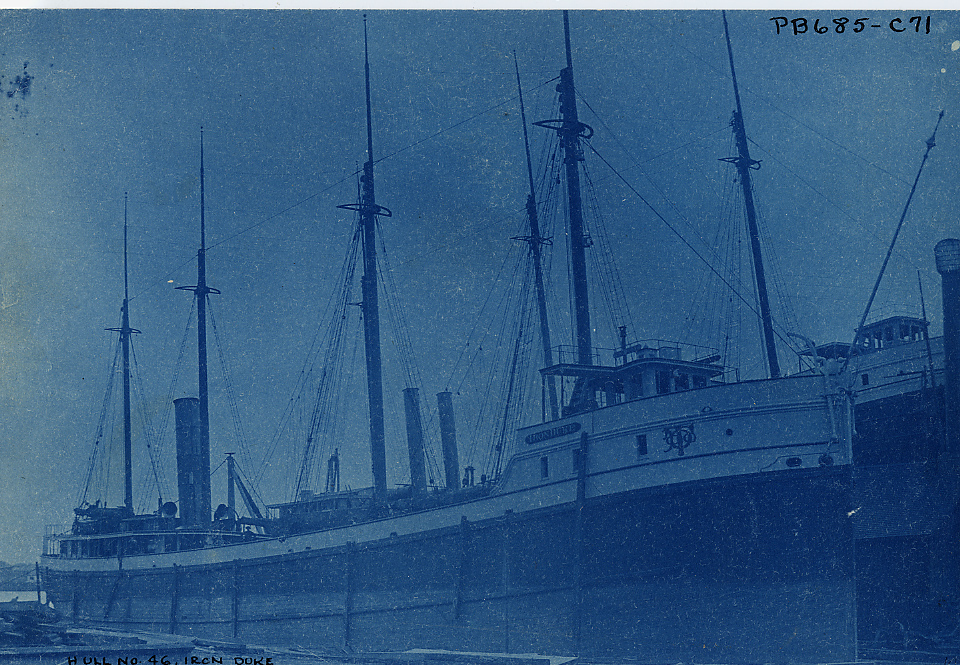
VESSEL INFORMATION - VESSEL NAME: HENRY B. HYDE SERVICE DATES: 1884-1904 SHIP BUILDER: J. McDonald BUILDER LOCATION: Maine, Bath ASSOCIATED PLACE: New York VESSEL HISTORY: Launched at Bath, Maine November, 1884 and at that time was the largest ship to have been built in Maine. Engaged mostly in the West Coast trade. Became a coal carrier in 1898. Stranded at Virginia Beach February 11, 1904. Wreckers worked on salvaging her and floated her off on September 21, 1904. She broke loose and stranded again south of Dam Neck Mills Lifesaving Station of September 22, 1904 and was abandoned shortly thereafter. SHIP OWNERS: B. Flint (1887); Pendleton, Carver & Nichols(1890); Flint & Co. (1899); subsequently owned by the California Shipping Co. (1900) VESSEL DIMENSIONS: 2,583.06 gross tons; 267' x 45' x 20.5' PLACE OF DISPOSAL: Virginia, Virginia Beach DATE OF DISPOSAL: 1904 ADDITIONAL INFORMATION: See "The Great Sailing Ships of History" / Issue No. 39 located in the object file.
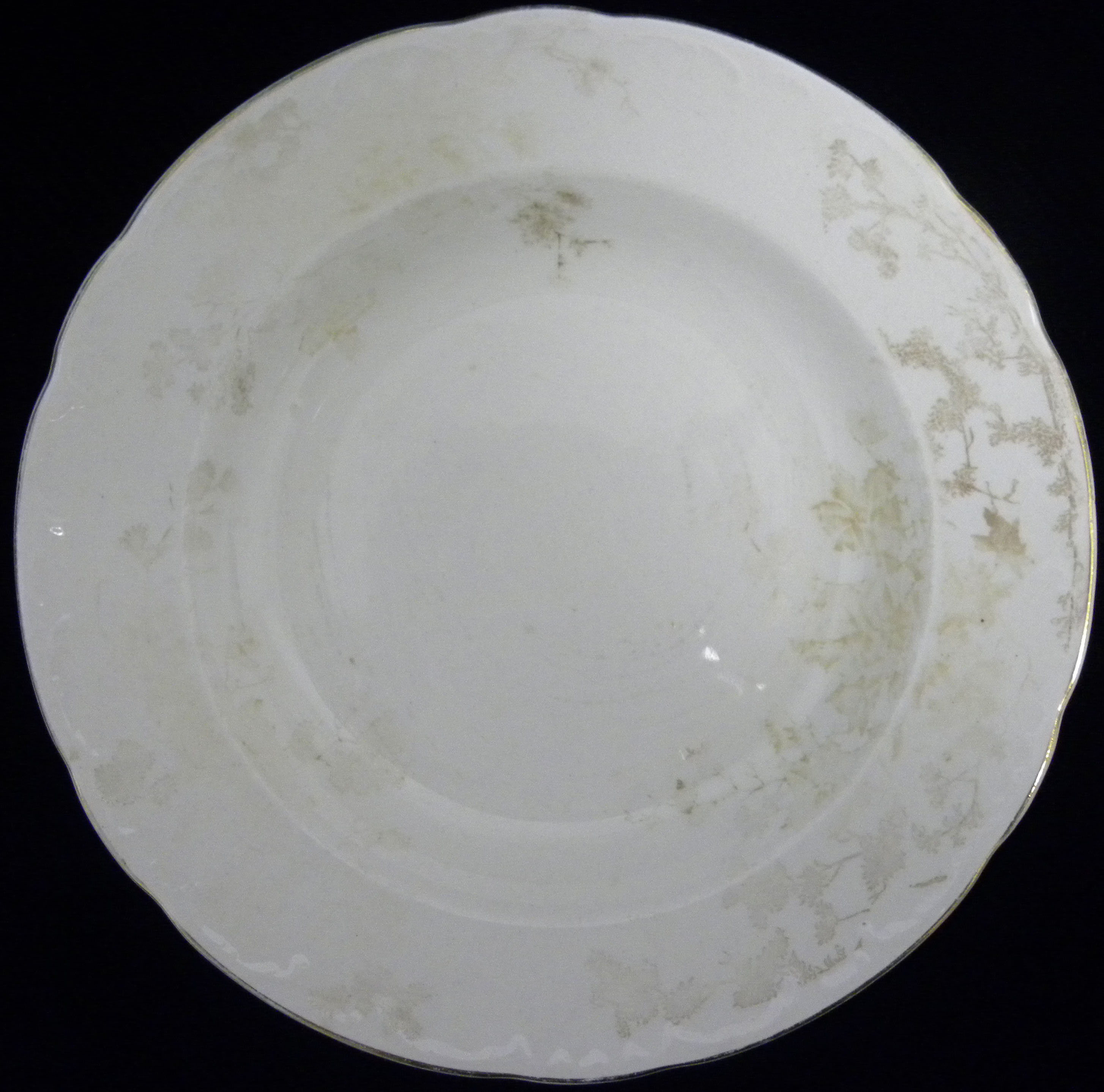
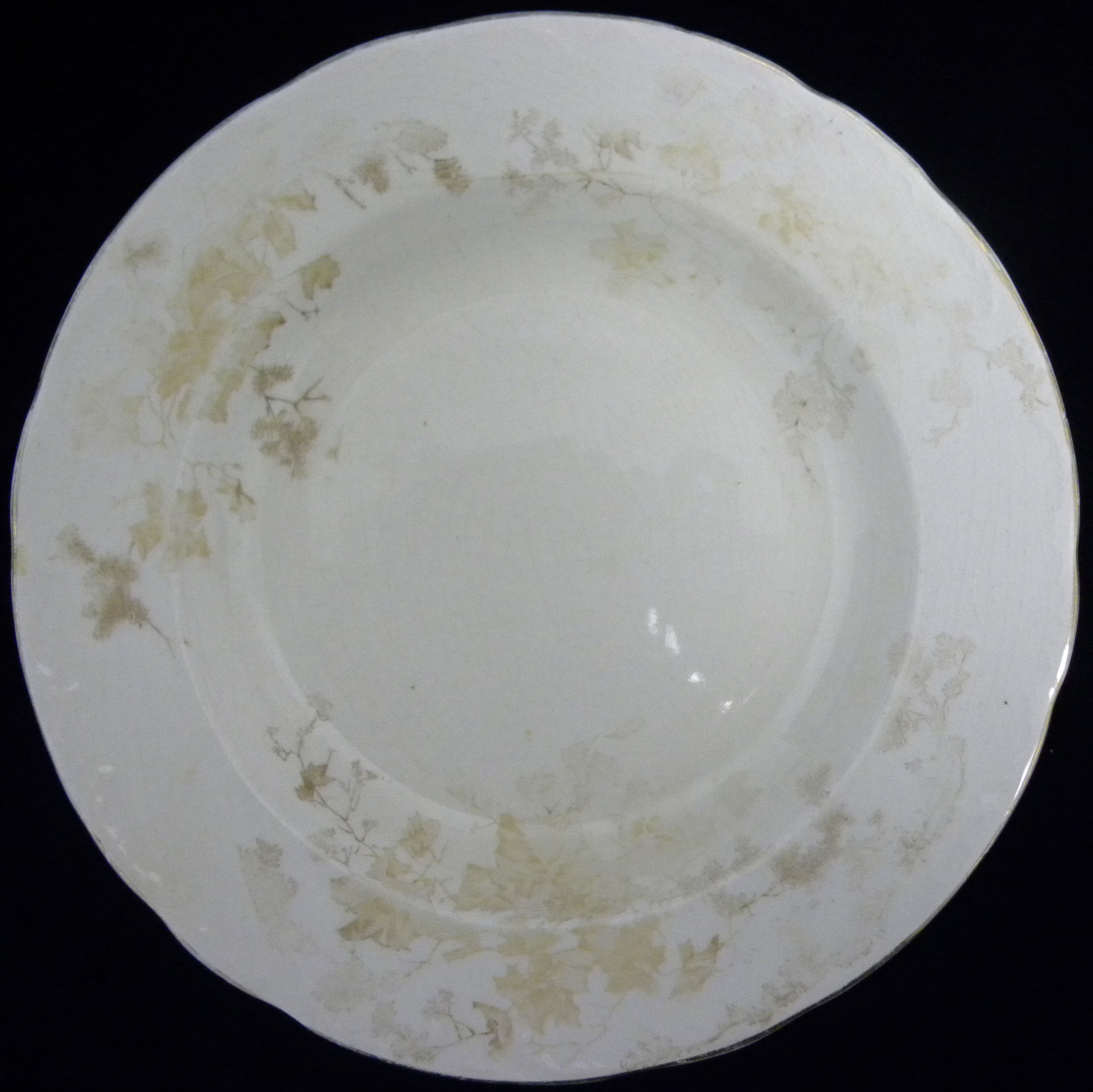
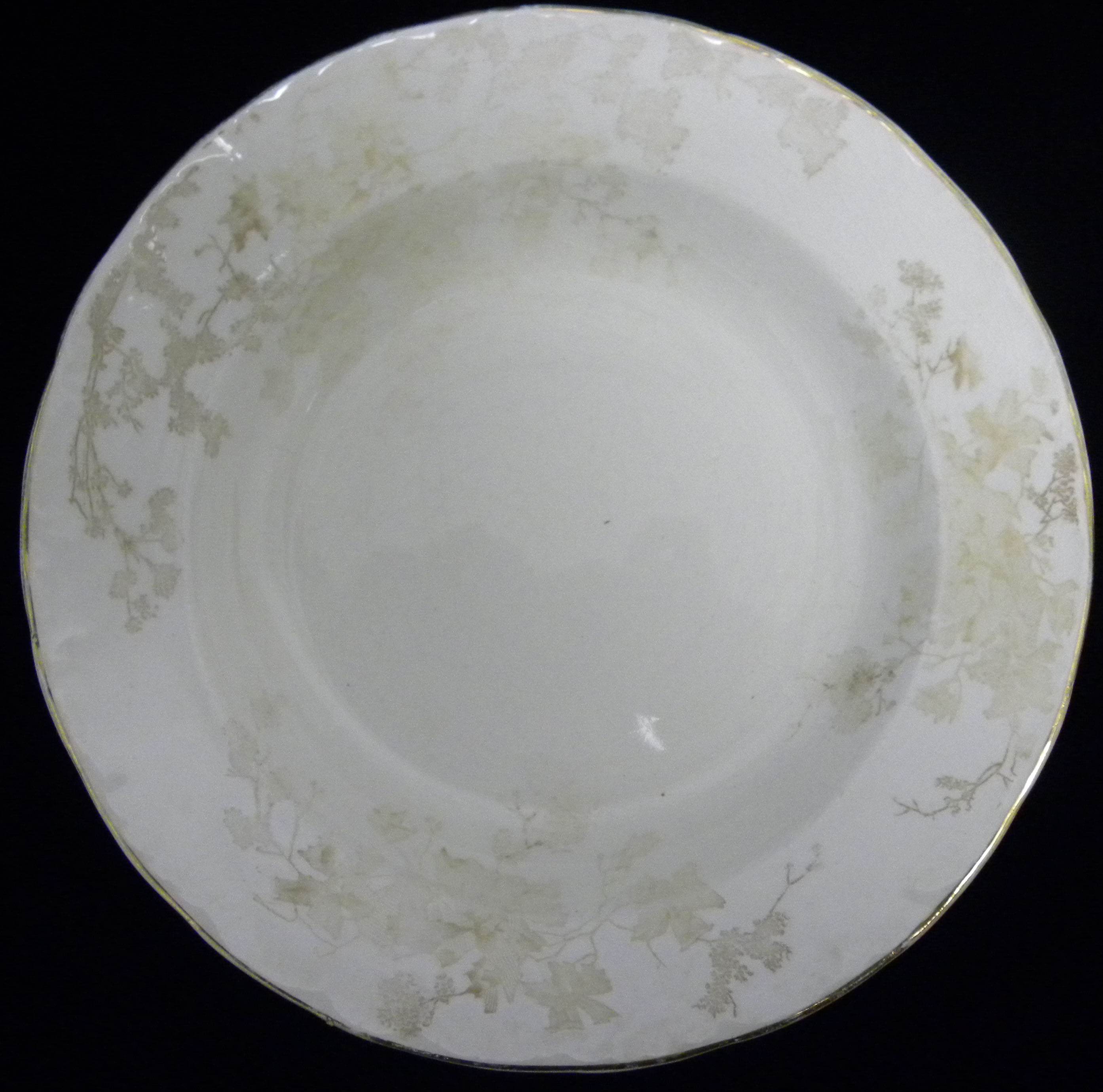
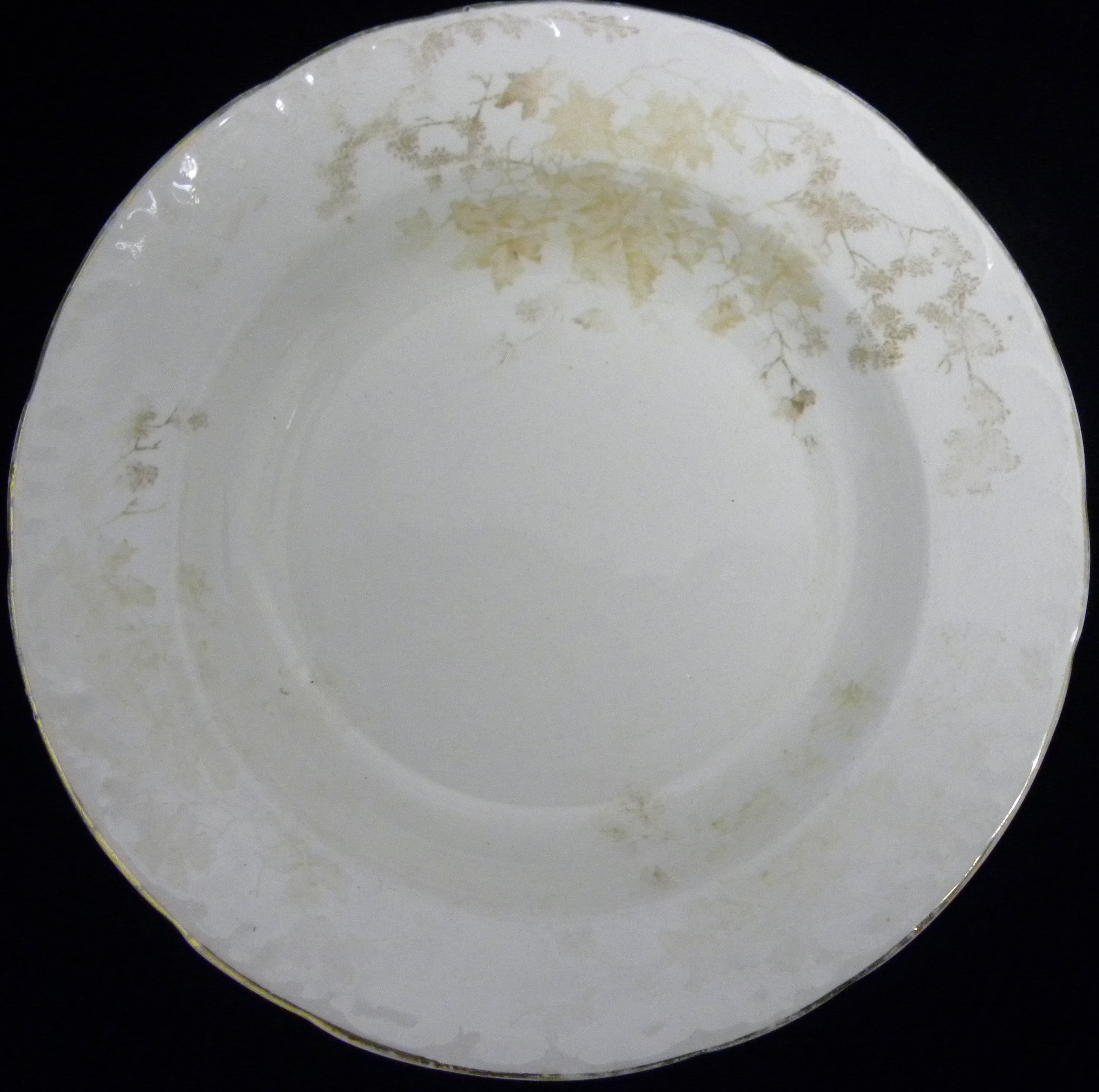
NOTES: White soup plate with brown transfer and gold from the Henry B. Hyde. The molded edges on the plate are outline in gold and the front has plant designs with different shades of brown, darker towards the edges and lighter towards the center. On the bottom is a Bridgwood & Son stamp with shield. VESSEL INFORMATION - VESSEL NAME: HENRY B. HYDE SERVICE DATES: 1884-1904 SHIP BUILDER: J. McDonald BUILDER LOCATION: Maine, Bath ASSOCIATED PLACE: New York VESSEL HISTORY: Launched at Bath, Maine November, 1884 and at that time was the largest ship to have been built in Maine. Engaged mostly in the West Coast trade. Became a coal carrier in 1898. Stranded at Virginia Beach February 11, 1904. Wreckers worked on salvaging her and floated her off on September 21, 1904. She broke loose and stranded again south of Dam Neck Mills Lifesaving Station of September 22, 1904 and was abandoned shortly thereafter. SHIP OWNERS: B. Flint (1887); Pendleton, Carver & Nichols(1890); Flint & Co. (1899); subsequently owned by the California Shipping Co. (1900) VESSEL DIMENSIONS: 2,583.06 gross tons; 267' x 45' x 20.5' PLACE OF DISPOSAL: Virginia, Virginia Beach DATE OF DISPOSAL: 1904
NOTES: White soup plate with brown transfer and gold from the Henry B. Hyde. The molded edges on the plate are outline in gold and the front has plant designs with different shades of brown, darker towards the edges and lighter towards the center. On the bottom is a Bridgwood & Son stamp with shield. VESSEL INFORMATION - VESSEL NAME: HENRY B. HYDE SERVICE DATES: 1884-1904 SHIP BUILDER: J. McDonald BUILDER LOCATION: Maine, Bath ASSOCIATED PLACE: New York VESSEL HISTORY: Launched at Bath, Maine November, 1884 and at that time was the largest ship to have been built in Maine. Engaged mostly in the West Coast trade. Became a coal carrier in 1898. Stranded at Virginia Beach February 11, 1904. Wreckers worked on salvaging her and floated her off on September 21, 1904. She broke loose and stranded again south of Dam Neck Mills Lifesaving Station of September 22, 1904 and was abandoned shortly thereafter. SHIP OWNERS: B. Flint (1887); Pendleton, Carver & Nichols(1890); Flint & Co. (1899); subsequently owned by the California Shipping Co. (1900) VESSEL DIMENSIONS: 2,583.06 gross tons; 267' x 45' x 20.5' PLACE OF DISPOSAL: Virginia, Virginia Beach DATE OF DISPOSAL: 1904
NOTES: White soup plate with brown transfer and gold from the Henry B. Hyde. The molded edges on the plate are outline in gold and the front has plant designs with different shades of brown, darker towards the edges and lighter towards the center. On the bottom is a Bridgwood & Son stamp with shield. VESSEL INFORMATION - VESSEL NAME: HENRY B. HYDE SERVICE DATES: 1884-1904 SHIP BUILDER: J. McDonald BUILDER LOCATION: Maine, Bath ASSOCIATED PLACE: New York VESSEL HISTORY: Launched at Bath, Maine November, 1884 and at that time was the largest ship to have been built in Maine. Engaged mostly in the West Coast trade. Became a coal carrier in 1898. Stranded at Virginia Beach February 11, 1904. Wreckers worked on salvaging her and floated her off on September 21, 1904. She broke loose and stranded again south of Dam Neck Mills Lifesaving Station of September 22, 1904 and was abandoned shortly thereafter. SHIP OWNERS: B. Flint (1887); Pendleton, Carver & Nichols(1890); Flint & Co. (1899); subsequently owned by the California Shipping Co. (1900) VESSEL DIMENSIONS: 2,583.06 gross tons; 267' x 45' x 20.5' PLACE OF DISPOSAL: Virginia, Virginia Beach DATE OF DISPOSAL: 1904
NOTES: This model is of a three masted ship with leg of mutton spanker. That is to say square sails on all three masts. Has double topsails. ADDITIONAL INFORMATION: Lubbock, Basil. The Down Easters: American Deep-water Sailing Ships 1869-1929.; Pouliot, Richard A. and Julie J. Sipwrecks on the Virginia Coast and the men of the United States Lifesaving Service. Tidewater Publishers; Merchant Vessels of the U.S., Washington. Government Printing Office.; Shipping Wonders of the World, The Drama of Lifesaving. page 235. London 1936-7. VESSEL INFORMATION - VESSEL NAME: HENRY B. HYDE SERVICE DATES: 1884-1904 SHIP BUILDER: J. McDonald BUILDER LOCATION: Maine, Bath ASSOCIATED PLACE: New York VESSEL HISTORY: Launched at Bath, Maine November, 1884 and at that time was the largest ship to have been built in Maine. Engaged mostly in the West Coast trade. Became a coal carrier in 1898. Stranded at Virginia Beach February 11, 1904. Wreckers worked on salvaging her and floated her off on September 21, 1904. She broke loose and stranded again south of Dam Neck Mills Lifesaving Station of September 22, 1904 and was abandoned shortly thereafter. SHIP OWNERS: B. Flint (1887); Pendleton, Carver & Nichols(1890); Flint & Co. (1899); subsequently owned by the California Shipping Co. (1900) VESSEL DIMENSIONS: 2,583.06 gross tons; 267' x 45' x 20.5' PLACE OF DISPOSAL: Virginia, Virginia Beach DATE OF DISPOSAL: 1904
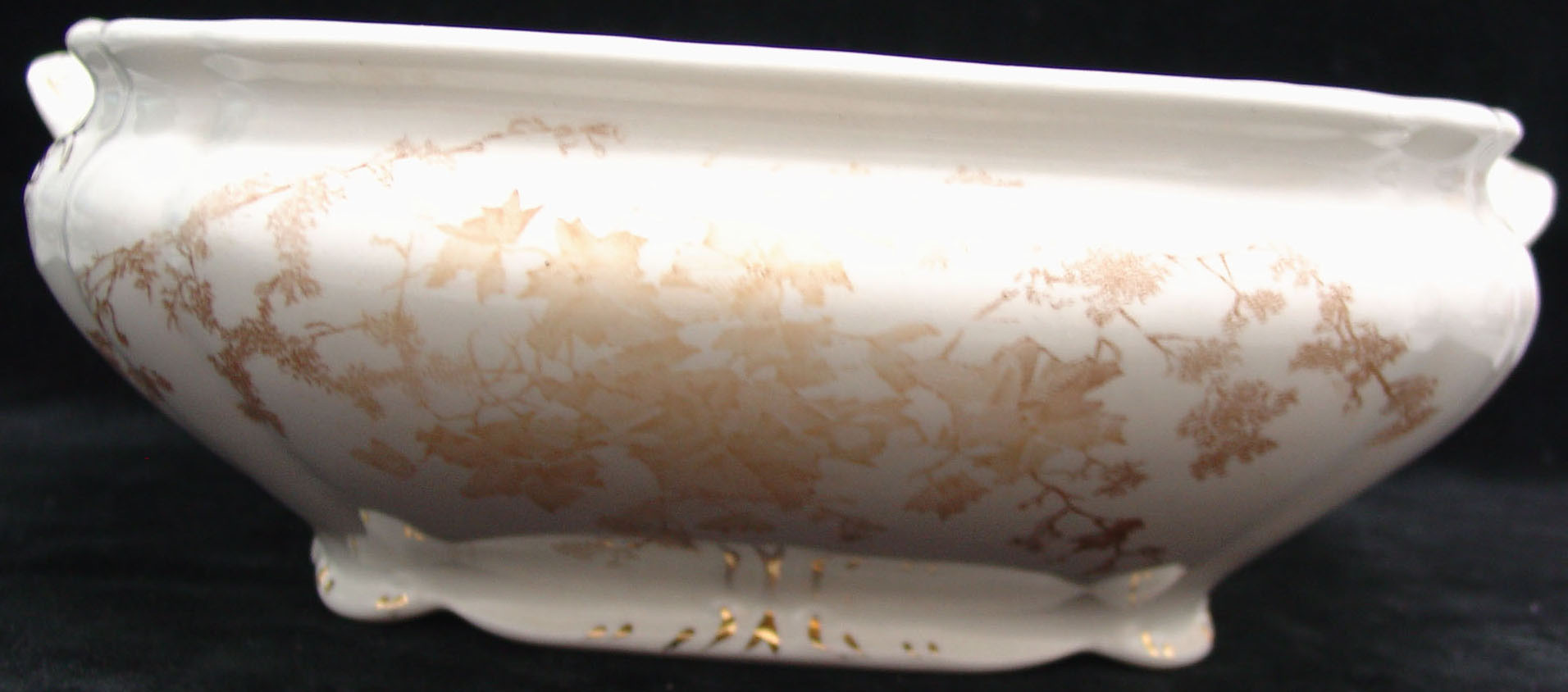
NOTES: White vegetable dish with brown transfer and gold. Molded plant designs are on the handle, outline in gold. There are also molded details on the foot, accented with gold. The two main sides have plant designs with different shades of brown, darker toward the edges and lighter towards the center. According to thepotteries.org, the mark on the bottom dates to 1891 and thereafter. Sampson Bridgwood & Son operated at the Anchor Pottery in Longton, Staffordshire. VESSEL INFORMATION - VESSEL NAME: HENRY B. HYDE SERVICE DATES: 1884-1904 SHIP BUILDER: Built in the Chapman and Flint yard by master shipwrights J. McDonald and Lermond BUILDER LOCATION: Maine, Bath DIMENSION: 268' length, 2,583 tons HOME PORT: New York VESSEL HISTORY: Launched at Bath, Maine November, 1884 and at that time was the largest ship to have been built in Maine. Engaged mostly in the West Coast trade. Became a coal carrier in 1898. On a voyage from New York to San Francisco the vessel was caught by a gale off the Virginia capes and stranded at Cape Henry in Virginia Beach on February 11, 1904. Wreckers worked on salvaging her and floated her off on September 21, 1904. She broke loose and stranded again south of Dam Neck Mills Lifesaving Station of September 22, 1904 and was abandoned shortly thereafter. SHIP OWNERS: B. Flint (1887); Pendleton, Carver & Nichols of Searsport, Maine (1890); Flint & Co. (1899); subsequently owned by the California Shipping Co. (1900) VESSEL DIMENSIONS: 2,583.06 gross tons; 267' x 45' x 20.5' PLACE OF DISPOSAL: Virginia, Virginia Beach DATE OF DISPOSAL: 1904
NOTES: White soup plate with brown transfer and gold from the Henry B. Hyde. The molded edges on the plate are outline in gold and the front has plant designs with different shades of brown, darker towards the edges and lighter towards the center. On the bottom is a Bridgwood & Son stamp with shield. VESSEL INFORMATION - VESSEL NAME: HENRY B. HYDE SERVICE DATES: 1884-1904 SHIP BUILDER: J. McDonald BUILDER LOCATION: Maine, Bath ASSOCIATED PLACE: New York VESSEL HISTORY: Launched at Bath, Maine November, 1884 and at that time was the largest ship to have been built in Maine. Engaged mostly in the West Coast trade. Became a coal carrier in 1898. Stranded at Virginia Beach February 11, 1904. Wreckers worked on salvaging her and floated her off on September 21, 1904. She broke loose and stranded again south of Dam Neck Mills Lifesaving Station of September 22, 1904 and was abandoned shortly thereafter. SHIP OWNERS: B. Flint (1887); Pendleton, Carver & Nichols(1890); Flint & Co. (1899); subsequently owned by the California Shipping Co. (1900) VESSEL DIMENSIONS: 2,583.06 gross tons; 267' x 45' x 20.5' PLACE OF DISPOSAL: Virginia, Virginia Beach DATE OF DISPOSAL: 1904
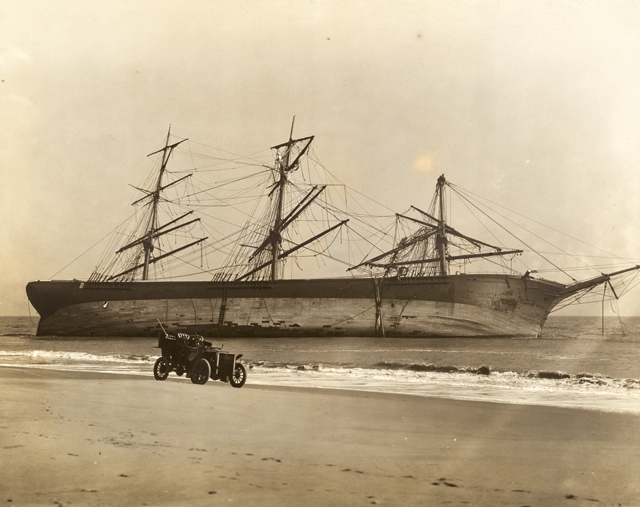
on verso: Henry B. Hyde (ship) New York. Built 1884 at Bath, Me. by John McDonald; owned by Flint & Co. Driven ashore at Virginia Beach, Va. and broken up by storm 1904. Edwin Levick Collection.
Broadside view of the ship on shoreline. An early automobile is parked on the sand near the water.
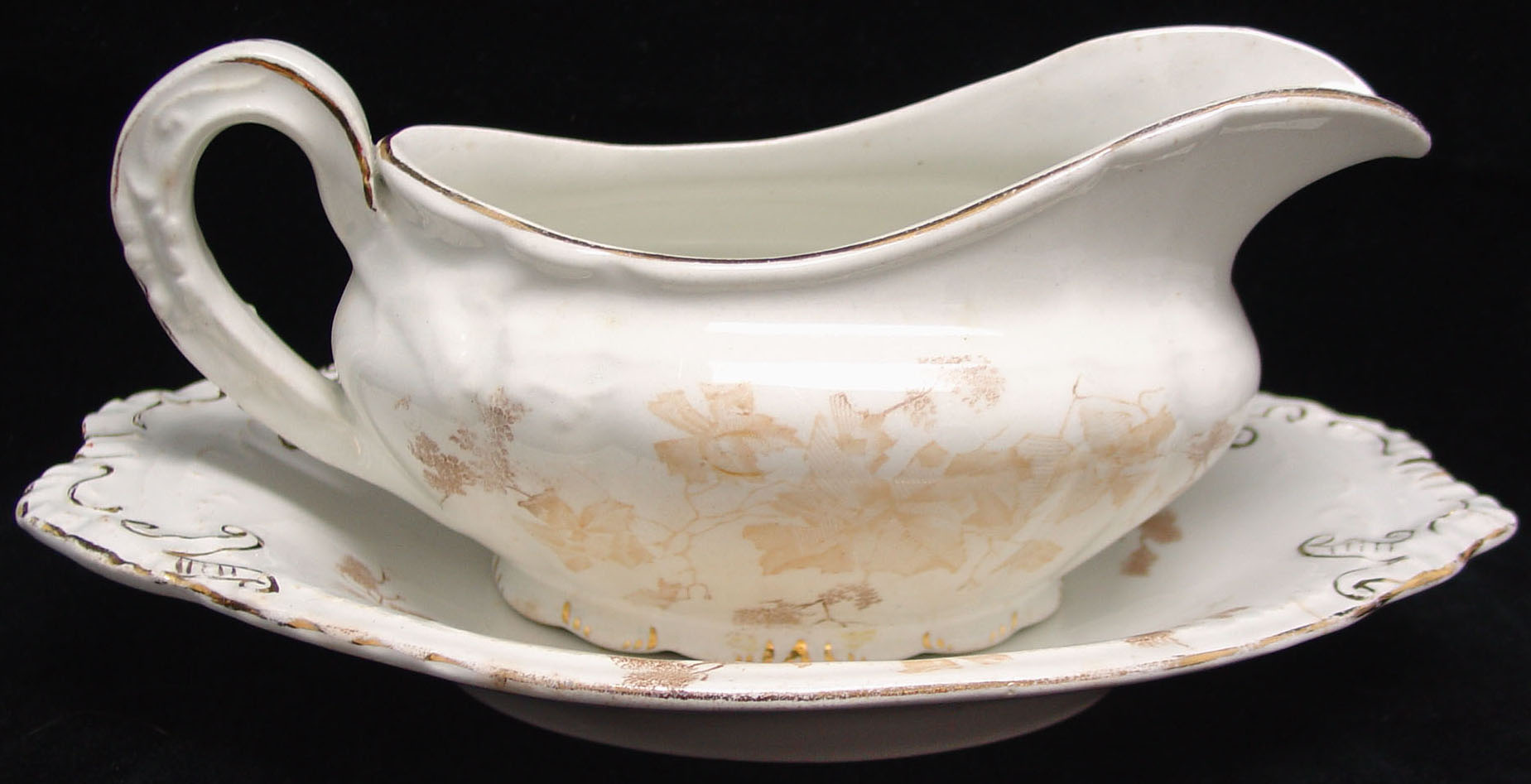
NOTES: White gravy boat and saucer from the Henry B. Hyde. Both pieces have gold around the rim and brown floral transfers. VESSEL INFORMATION - VESSEL NAME: HENRY B. HYDE VESSEL TYPE: MERCHANT SHIP, 3 MAST SERVICE DATES: 1884-1904 SHIP BUILDER: J. McDonald BUILDER LOCATION: Maine, Bath ASSOCIATED PLACE: New York VESSEL HISTORY: Launched at Bath, Maine November, 1884 and at that time was the largest ship to have been built in Maine. Engaged mostly in the West Coast trade. Became a coal carrier in 1898. Stranded at Virginia Beach February 11, 1904. Wreckers worked on salvaging her and floated her off on September 21, 1904. She broke loose and stranded again south of Dam Neck Mills Lifesaving Station of September 22, 1904 and was abandoned shortly thereafter. SHIP OWNERS: B. Flint (1887); Pendleton, Carver & Nichols(1890); Flint & Co. (1899); subsequently owned by the California Shipping Co. (1900) VESSEL DIMENSIONS: 2,583.06 gross tons; 267' x 45' x 20.5' PLACE OF DISPOSAL: Virginia, Virginia Beach DATE OF DISPOSAL: 1904 INVENTORY: Gravy boat dish. One component part.
Henry B. Hyde, New York. Built 1884 at Bath Me. by John McDonald. owned by Flint & Co. 2483 T. 267.9 x 45 x 20.5. Driven ashore at Virginia Beach, Va. and broken up by storm, 1904.
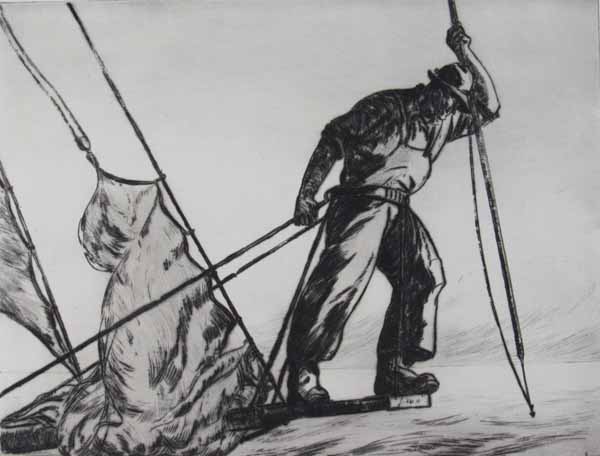
LABEL COPY: SWORDFISHERMAN Gifford Beal (American, 1879-1956) Etching Gift of Mr. and Mrs. Henry B. Holt 77.27 (Sea Images in Black and White, November 4, 1978-March 4, 1979)
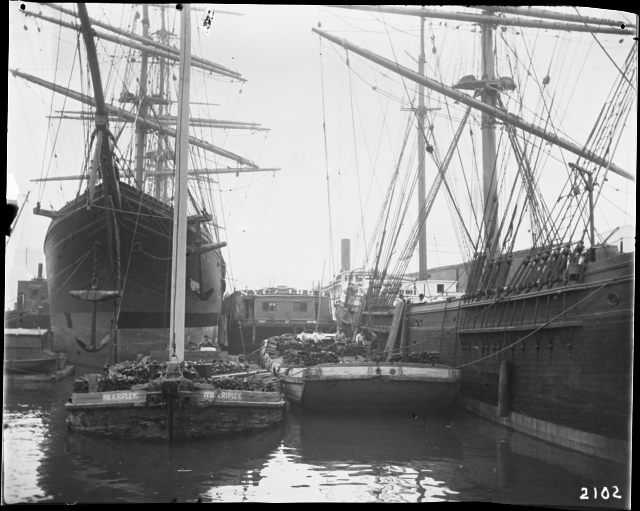
GUY C. GOSS (BARK: 1879) - HENRY B. HYDE (SHIP: 1884)
Guy C. Goss - barque - Henry B. Hyde - ship; 2102
Sailing ships–United States.; Barks (Sailing ships)–United States.; Barges–United States.; Stevedores–United States.; Loading and unloading–United States.
Shows two sailing ships with two barges loaded with cargo alongside one ship. Men on one barge are moving cargo onto the ship. Stanton's notebooks contain the following information about this item: "May 22 96"
PHILADELPHIA - PENNSYLVANIA - UNITED STATES - Publisher
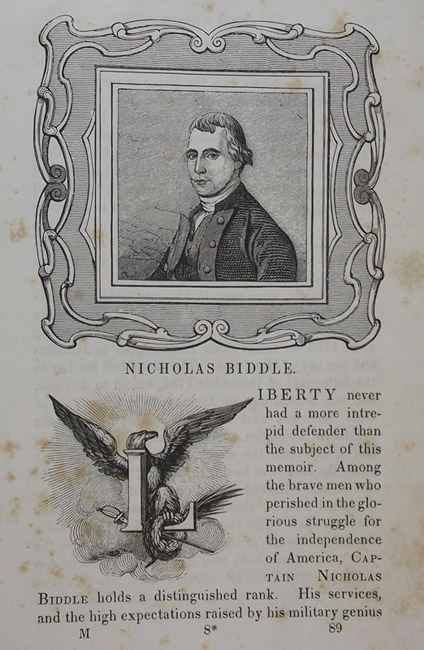
NOTES: From page 89 of 'American Naval Biography, comprising Lives of the Commodores and other Commanders...' by John Frost, Original drawings by W. Croome, James Hamilton and Others. Published by E. H. Butler in Philadelphia in 1844. The portrait of Biddle was drawn and engraved by Henry B. Brown. Biography between pages 89 and 105.
NOTES: The lock and its hardware were missing from this cabinet when it arrived at the museum. A new lock and hardware were put in place in 1973. VESSEL INFORMATION - VESSEL NAME: HENRY B. HYDE SERVICE DATES: 1884-1904 SHIP BUILDER: J. McDonald BUILDER LOCATION: Maine, Bath ASSOCIATED PLACE: New York VESSEL HISTORY: Launched at Bath, Maine November, 1884 and at that time was the largest ship to have been built in Maine. Engaged mostly in the West Coast trade. Became a coal carrier in 1898. Stranded at Virginia Beach February 11, 1904. Wreckers worked on salvaging her and floated her off on September 21, 1904. She broke loose and stranded again south of Dam Neck Mills Lifesaving Station of September 22, 1904 and was abandoned shortly thereafter. SHIP OWNERS: B. Flint (1887); Pendleton, Carver & Nichols(1890); Flint & Co. (1899); subsequently owned by the California Shipping Co. (1900) VESSEL DIMENSIONS: 2,583.06 gross tons; 267' x 45' x 20.5' PLACE OF DISPOSAL: Virginia, Virginia Beach DATE OF DISPOSAL: 1904
Fulfilment of three remarkable prophecies in the history of the great Empire State relating to the development of steamboat navigation and railroad transportation, 1808-1908 - by Henry Whittemore
The book of old ships and something of their evolution and romance : - wherein will be found drawings and descriptions of many varieties of vessels, both long and round, showing their development from most remote times ; the portraiture of their progress, their garnishment, etc., etc., together with divers dissertations upon the origins of shipping ; also an appendix wherein will be discovered to the inquisitive much information appertaining to the ancient uses and customs of the sea and mariners - illustrated in line and color with a variety of original designs of shipping compiled from authentic sources drawn by Gordon Grant ; text by Henry B. Culver
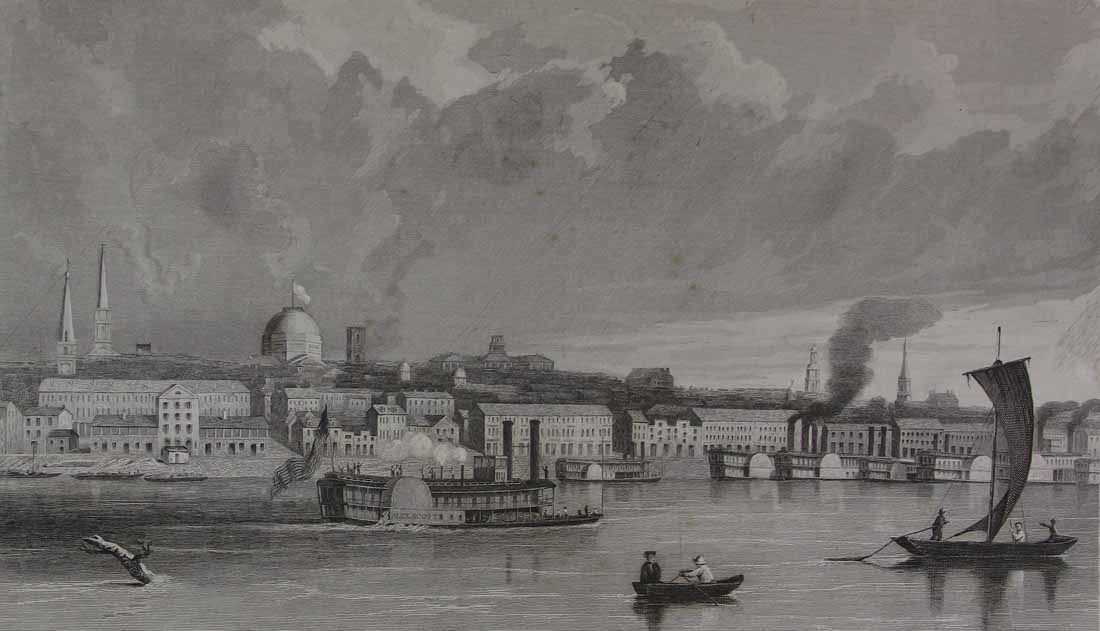
MISSOURI, ST. LOUIS; RELATED PLACE: MISSOURI, ST. LOUIS, MISSISSIPPI RIVER
NOTES: There is extant a fifth general view of St. Louis by Wild, which may be his last picture of the city. Taken from midriver, it presents a close-up of the waterfront; the Mississippi, however, is made to look like a placid lake or bay. Engraved by J. T. Hammond of St. Louis, it was published (a plate four and one-half by seven and three-quarters inches) in the Cincinnati Ladies Repository for January 1845, as an "entirely new" engraving. This print, however, was extant as a letterhead early in 1844, for Henry B. Whipple picked up a copy when he visited the city in the first week in April.25 So far as can be determined Wild made no lithograph of this picture.
Navigation–Early works to 1800.; Navigation–Tables.
Navigation New Modelled, - or, A Treatise of Geometrical, Trigonometrical, Arithmetical,Instrumental, and Practical Navigation; Teaching How to Keep a Reckoning, both in Latitude andLongitude, without Tables or Instruments, by a New Method never yet Published: Illustrated withPractical Examples of keeping a Journal, and correcting it by an Observation, with a New Way offinding the Variation, and Time of High-Water at any known Port. Together With All Necessary Tables,calculated to the New Stile, and the Projection of the Sphere Orthographic and Stereographic. AlsoCurrent Sailing, with other Pleasant Questions, and how to Correct the Longitude by a SolarObservation - by Henry Wilson; revised and corrected by William Mountaine
Recovery and restoration : - U.S. foreign policy and the politics of reconstruction of West Germany's shipbuilding industry, 1945-1955 - Henry Burke Wend
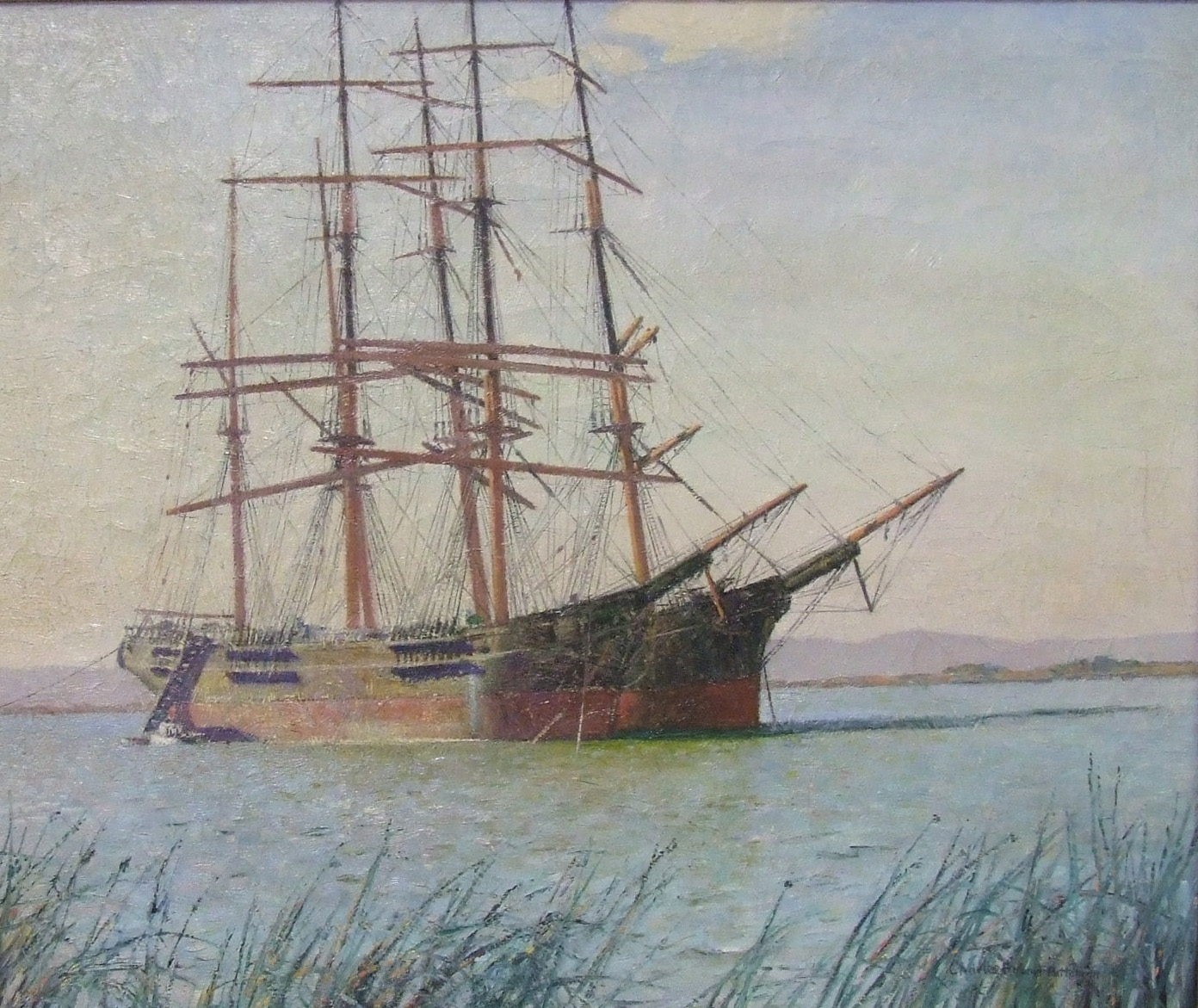
LABEL COPY: EMILY F. WHITNEY AND MCLAURIN Oil on Canvas by Charles Robert Patterson (American, 1878-1958) Gift of Delano McKelvey QO 1065 (Sept. 1984) LABEL COPY: BARKS EMILY F. WHITNEY AND McLAURIN The impressionistic style of Charles Robert Patterson belies the fact that he was a former blue water seaman, one who rounded Cape Horn at least four times in square-riggers similar to these. He painted the two barks when they were laid up in the Sacramento River in the 1920's. Charles robert Patterson (Anglo-American, 1879-1959) Oil on Canvas (12/89) LABEL COPY: BARKS EMILY F. WHITNEY AND MCLAURIN Charles Robert Patterson (Anglo-American, 1878-1959) Oil on canvas, circa 1927 Gift of Mr. Delano McKelvey 65.156 QO 1065 Patterson's impressionistic style believes the fact that his ship portraits are the work of a former blue water seaman, one who rounded Cape Horn at least four times in square-riggers similar to these. He painted the two barks when they were laid up in the Sacramento River estuary northeast of San Francisco. VESSEL INFORMATION - VESSEL NAME: EMILY F. WHITNEY VESSEL TYPE: MERCHANT BARK, AMERICAN SHIPBUILDER: ABIEL GOVE BUILDER LOCATION: EAST BOSTON, MASSACHUSETTS SHIP OWNERS: J.H. FLITNER, LEONARD WHITNEY, L.A. ROBY SHIP'S CAPTAIN: CAPTAIN HENRY B. ROLLINS VESSEL HISTORY: in 1898, she was driven ashore in Shanghai during a typhoon, but suffered little damage. She changed hands several times after 1900, being engaged in sugar, lumber and salmon trade. In December 1828, she was purchased by Earle Derby of Standard Oil, who had her overhauled and rigged as a bark as she had been during her last active years. He anchored her in Sausalito, California to be used as a museum. Sea Scouts trained on her. On December 2, 1940, some small boys set her on fire and she was allowed to burn to the water line.
BOSTON - MASSACHUSETTS - UNITED STATES - Manufacturer; WINTHROP - MASSACHUSETTS - UNITED STATES - Related Institution
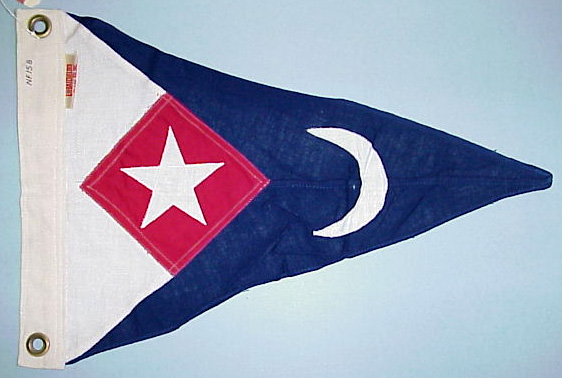
SHORT DESCRIPTION: Triangular burgee with white triangle beginning at hoist edge, pointing out 6-7/8" from webbing. A red diamond, 6-1/4" high x 6-7/16" wide, is stitched over the point of the white triangle and a white five pointed star, 3-1/2" in diameter, is found in the center of the diamond. Blue fabric makes up the rest of burgee, which gives the blue element an arrow type shape. 5-1/2" from the tip of the fly edge a white crescent moon, 3-5/8" high x 2-1/2" wide, is stitched with its curved side towards the fly edge. There are two grommets on the hoist edge, one near each end of the webbing, for flying the burgee. NOTES: The Pleasant Park Yacht Club was founded on August 12, 1910 in Winthrop, Massachusetts by Henry B. Fiske, Fred J. Karrer, Nathaniel T. Freeman, Charles E. Clarke, Eli Moore, Augustus E. Wyman, Gilbert W. Rich, William A. Clisby, Leonard T. Farris, Charles S. Winne, Hugh J. Shaw and others. Land fronting Pleasant Street was purchased on September 18, 1910 and an appropriate flag raising ceremony was held a few weeks later on the 27th. A charter was granted by the Commonwealth of Massachusetts on November 1, 1910. On September 2, 1911 its one-story club house was completed and dedicated.
PT boat : - Bob Reed wins his command at Melville - by Henry B. Lent ; illustrated with officials photographs, U.S. Navy ; and photographs taken at the Melville base by Carroll Van Ark
United States–History–Naval operations. Civil War, 1861-1865
This collection consists of items relating to the service of Walter Jacobs in the United States Navy during the Civil War. The most notable item is Jacobs' personal journal. The journal covers roughly the last year and a half of Jacobs' three-year enlistment, from August 23, 1863 to December 8, 1864. During the time that Jacobs kept this journal, he served aboard two vessels, the screw steamer Flambeau and the ironclad monitor Nantucket. While Jacobs does provide accounts of military action, the most significant aspect of his journal are the rich details and anecdotes he gives about life on board a Union navy vessel and ironclad. Jacobs also offers his opinion on Navy life, the Union war effort, the U.S. government, and African Americans' service in the Union army and navy, among other things. The names of most other vessels contacted or observed are also included. These include those supplying provisions and coal, bringing mail, etc. Most entries begin with a brief description of the weather and direction of the wind. Also included in this collection is a 14-page, loose-leaf transcript of a radio program "What Are You Reading?" that was broadcast by station WELI in New Haven, Connecticut on March 10, 1941. The host of the program was Elida B. Sterling, who was evidently a neighbor of Ella Jacobs Stevens. On her program, Sterling describes the journal and provides brief anecdotes from it. She also provides brief biographical information on Walter Jacobs. Associated with the transcript are a hand-written note in ink and a typewritten letter. The note identifies "Ellenore Jacobs Stevens" both as "Nana" and "his daughter." Ellenore is indeed Ella Clarissa Jacobs, Walter Jacob's eighth child and the grandmother of the author. The author of the note, Peter Daughenbaugh, provides an anecdote of his great-grandfather Walter Jacobs in later life. The typewritten letter is addressed to Ella and is from Elida Sterling. The letter notes the inclusion of a copy of the typescript "for Jane" and concludes with personal content. "Jane" is Jane Daughenbaugh, the mother of Peter. Mother and grandmother gave Peter the Jacobs journal in 1956, and he kept it until donating it to The Mariners' Museum in 2011. The final item in this collection is pencil sketch of an ironclad monitor that appears to be in action. The artist and date of the drawing is unknown. This drawing is similar to a known steel engraving of the monitor Montauk's destruction of the Rattlesnake, the ex-Confederate steamer Nashville, on 28 Feb. 1863. The engraving appeared in Harper's Weekly in January-June 1863.
HMS SERAPIS (SHIP-OF-THE-LINE: 1779-1781); USS BONHOMME RICHARD (FRIGATE: 1779)
NEW YORK; UNITED STATES
27 BEEKMAN STREET - NEW YORK - NEW YORK - UNITED STATES - Publisher
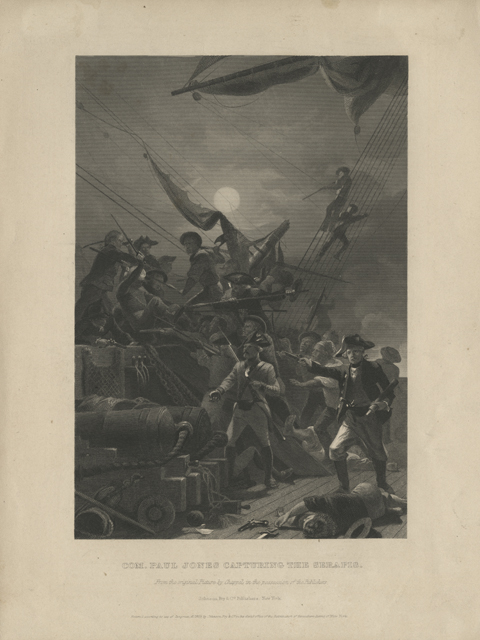
SHORT DESCRIPTION: Black and white image of a deck scene depicting John Paul Jones and crew fighting in hand-to-hand combat in the moonlight. Jones is holding a telescope in one hand and a pistol in the other. A second pistol is in his belt. It appears as if the two ships are side by side and the crew of the HMS SERAPIS is climbing over the side of the ship and onto the deck where John Paul Jones is standing. There is a man firing a gun from the rigging. The combat is taking place with swords, bayoneted rifles and small spears. Dead and injured are laying on the deck around Jones. Comes from 'Battles of the United States by Sea and Land' by Henry B. Dawson, 1858. The image appears after page 556 in book I. NOTES: Excerpts from 'A Naval History of the American Revolution' by Gardner Weld Allen, pages 442-485: In January 1779, the French purchased a 14-year old East Indiaman called Duc de Duras. It was converted into a man-of-war despite being structurally weak and a slow sailer by Captain John Paul Jones. The vessel was renamed Bonhomme Richard in honor of Benjamin Franklin, Jones's friend and benefactor. Jones spent months preparing for a cruise against the English islands. The American frigate Alliance was detained in France by Franklin to support Jones's expedition. Three French vessels, Pallas, a merchantman or privateer fitted out as a 32-gun frigate; Cerf, an 18-gun cutter; and Vengeance, a 12-gun brigantine, were also given to Jones. The squadron was ready for sea by the middle of June and sailed from Groix Roads, near L'Orient on June 19th on a shakedown cruise during which a convoy would be escorted to Bordeaux and other ports. Franklin's orders to Jones were to cruise to the north of the British Isles and after six weeks put into Texel in order to convoy vessels from Holland to France. The squadron sailed from Groix Roads on August 14, 1779. On the 23rd the squadron was off Cape Clear. Two prizes had been taken and sent back to L'Orient. A third was taken by boat action but later lost in a fog. The Cerf dropped out of the expedition after receiving damage in a gale on August 26th. The same gale separated the ships of the squadron, but Bonhomme Richard and Vengeance proceeded northward and were off Cape Wrath by September 1st where they fell in with the Alliance and prize she had taken. The same day a British letter of marque was taken. These were later given up by Danish authorities to the British consul. On September 2nd the Pallas rejoined the squadron. The squadron cruised a few days between Orkney and Shetland and took a few unimportant prizes. Another gale and adverse winds prevented the squadron from sighting land again until September 13th when the Cheviot Hills were sighted. Two colliers were taken on the 14th. One of the prizes was sunk during a gale on the 17th. British Revenue Cutters specially fitted out and armed for service against the American squadron alerted the British population about the approached of Jones's squadron. The squadron sailed south and a few more prizes were taken. By September 21st the squadron was off Flamborough Head at which point two brigs were captured and a small fleet of vessels were chased. On September 23rd, the squadron encountered a Baltic fleet of 41 vessels under convoy by the 44-gun [but carrying 50 guns] frigate HMS Serapis, Captain Richard Pearson, and the hired armed ship Countess of Scarborough. Bonhomme Richard and Serapis entered a bitter engagement about 7:00PM. Jones described the action in an October 3rd report to Benjamin Franklin: "The battle being thus begun was continued with unremitting fury. Every method was practised on both sides to gain an advantage and rake each other, and I must confess that the enemy's ship, being much more manageable than the Bonhomme Richard, gained thereby several times an advantageous situation, in spite of my best endeavors to prevent it. As I had to deal with an enemy of greatly superior force, I was under the necessity of closing with him, to prevent the advantage which he had over me in point of manoeuvre. It was my intention to lay the Bonhomme Richard athwart the enemy's bow, but as that operation required great dexterity in the management of both sails and helm and some of our braces being shot away, it did not exactly succeed to my wishes. The enemy's bowsprit, however, came over the Bonhomme Richard's poop by the mizen mast and I made both ships fast together in that situation, which by the action of the wind on the enemy's sails, forced her stern close to the Bonhomme Richard's bow, so that the ships lay square alongside of each other, the yards being all entangled and the cannon of each ship touching the opponent's side. "When this position took place it was eight o'clock, previous to which the Bonhomme Richard had received sundry eighteen pounds shot below the water and leaked very much. My battery of 12-pounders, on which I had placed my chief dependance, being commanded by [1st] Lieut. [Richard] Dale and Col. Weibert and manned principally with American seamen and French volunteers, were entirely silenced and abandoned. As to the six old 18-pounders that formed the battery of the lower gundeck, they did no service whatever; two out of three of them burst at the first fire and killed almost all the men who were stationed to manage them. Before this time too, Col. De Chamillard, who commanded a party of twenty soldiers on the poop, had abandoned that station after having lost some of his men; these men deserted their quarters. I had now only two pieces of cannon, 9-pounders on the quarter deck, that were not silenced, and not one of the heavier cannon was fired during the rest of the action. The purser, Mr. Mease, who commanded the guns on the quarter deck, being dangerously wounded in the head, I was obliged to fill his place and with great difficulty rallied a few men and shifted over one of the lee quarter-deck guns, so that we afterwards played three pieces of 9-pounders upon the enemy. The tops alone seconded the fire of this little battery and held out bravely during the whole of the action, especially the main top where Lieut. Stack commanded. I directed the fire of one of the three cannon against the mainmast with doubleheaded shot, while the other two were exceedingly well served with grape and canister-shot to silence the enemy's musketry and clear her decks, which was at last effected. "The enemy were, as I have since understood, on the instant of calling for quarters, when the cowardice or treachery of three of my under officers induced them to call to the enemy. The English commodore asked me if I demanded quarters and, I having answered him in the most determined negative, they renewed the battle with double fury. They were unable to stand the deck, but the fire of their cannon, especially the lower battery, which was entirely formed of 18-pounders, was incessant. Both ships were set on fire in various places and the scene was dreadful beyond the reach of language. To account for the timidity of my three under officers, I mean the gunner, the carpenter, and the master-at-arms, I must observe that the two first were slightly wounded, and as the ship had received various shots under water, and one of the pumps being shot away, the carpenter expressed his fear that she would sink and the other two concluded that she was sinking, which occasioned the gunner to run aft on the poop, without my knowledge, to strike the colors. Fortunately for me, a cannon ball had done that before by carrying away the ensign staff; he was therefore reduced to the necessity of sinking, as he supposed, or of calling for quarter and he preferred the latter. "All this time the Bonhomme Richard had sustained the action alone and the enemy, though much superior in force, would have been very glad to have got clear, as appears by their own acknowledgments and their having let go an anchor the instant that I laid them on board, by which means they would have escaped, had I not made them well fast to the Bonhomme Richard. At last, at half past nine o'clock, the Alliance appeared and I now thought the battle at an end, but to my utter astonishment he discharged a broadside full into the stern of the Bonhomme Richard. We called to him for God's sake to forbear firing into the Bonhomme Richard, yet he passed along the off side of the ship and continued firing. There was no possibility of his mistaking the enemy's ship for the Bonhomme Richard, there being the most essential difference in their appearance and construction; besides, it was then full moonlight and the sides of the Bonhomme Richard were all black, while the sides of the prizes were yellow. Yet, for the greater security, I showed the signal of our reconnoissance by putting out three lanthorns, one at the head (bow), another at the stern (quarter), and the third in the middle, in a horizontal line. Every tongue cried that he was firing into the wrong ship, but nothing availed; he passed round firing into the Bonhomme Richard's head, stern, and broadside, and by one of his vollies killed several of my best men and mortally wounded a good officer on the forecastle. "My situation was really deplorable. The Bonhomme Richard received various shots under water from the Alliance, the leak gained on the pumps, and the fire increased much on board both ships. Some officers persuaded me to strike, of whose courage and good sense I entertain a high opinion. My treacherous master-at-arms let loose all my prisoners without my knowledge and my prospect became gloomy indeed." The prisoners were much frightened, believing that the ship was sinking, and were at once put to work at the pumps; otherwise, by reinforcing the enemy, they would surely have turned the scale in his favor. "I would not, however, give up the point. The enemy's mainmast began to shake, their firing decreased, ours rather increased, and the British colors were struck at half an hour past ten o'clock." Reports by Dale and Captain Pearson indicated that a hand grenade thrown into the lower decks of Serapis from one of the ship's tops (which had unknowingly been taken over by the Americans) ignited loose gunpowder and sparked a fire that spread from cartridge to cartridge all the gun deck and "blew up the whole of the people and officers that were quartered abaft the mainmast, from which unfortunate circumstance all those guns were rendered useless for the remainder of the action." Both ships were severely damaged in the action. Bonhomme Richard was on fire in several placed and leaky rapidly with five feet of water in the hold, one pump was shot away and the other three were barely able to keep the water from gaining. Jones described the damage to Bonhomme Richard as "the rudder was cut entirely off the stern frame and the transums were almost entirely cut away; the timbers, by the lower deck especially, from the mainmast to the stern, being greatly decayed with age, were mangled beyond my power of description." Both sides of the ship for a great distance were wholly shot away, leaving little support for the upper deck, and projectiles passed through without hitting anything. The mainmast and mizzen-topmast of the Serapis fell overboard immediately after her surrender and she was otherwise much injured. It was only through Jones's determination not to yield that won this battle. Serapis's consort, the Countess of Scarborough, was engaged and taken by the Pallas. Jones blamed the convoy's escape on the disinclination of the French captains of Alliance and Vengeance to pursue it. Bonhomme Richard defied all efforts to save her and sank about 36 hours later at 11:00AM on September 25th. Jones took command of Serapis, erected a jury mainmast and sailed her to Texel, arriving on October 3rd. After Jones spent three months refitting his squadron, most of which were transferred to French flags to ease tensions between the Dutch and British, the Dutch ordered Jones in USS Alliance (the only vessel of the squadron that remained under the American flag) to depart on the first favorable wind. Jones managed to leave Texel on December 27, 1779 and successfully evaded a British blockading squadron. Serapis was eventually sold at L'Orient and the Countess of Scarborough was sold at Dunkirk.

 Full-size image
 Full-size image
 Full-size image
 Full-size image
 Full-size image
 Full-size image
 P0001.011-01 - PK8087
 P0002.001-01-003-005194
 P0001.011-01 - PK20
 Full-size image
 P0001.011-01 - PK3275-c267
 P0001.011-01 - PK6265
 Full-size image
 P0001.011-01 - PK4475
 P0001.011-01 - PK3144
 77-27
 MS0094-2102 Guy C Cross
 le3109
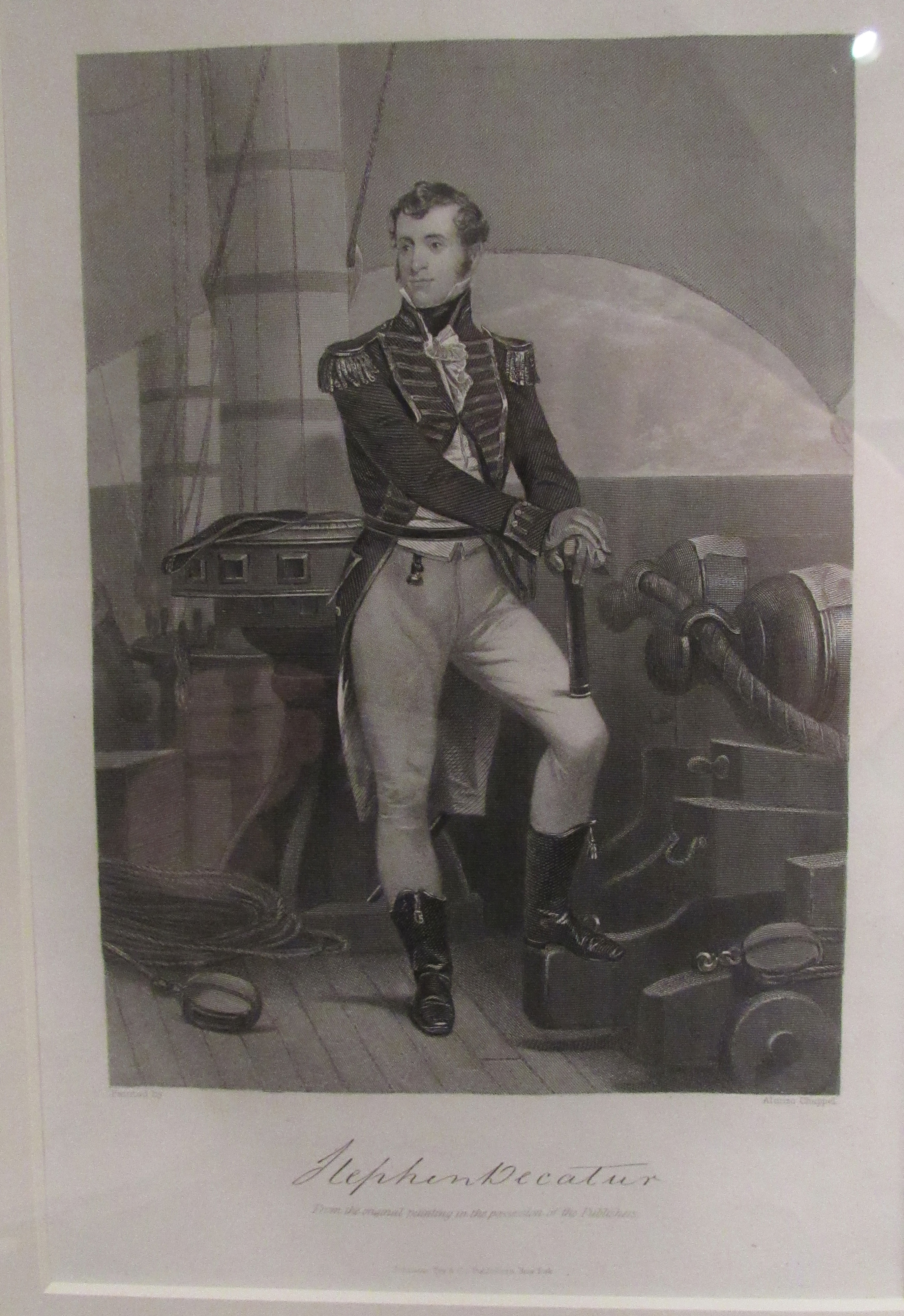 LE2552
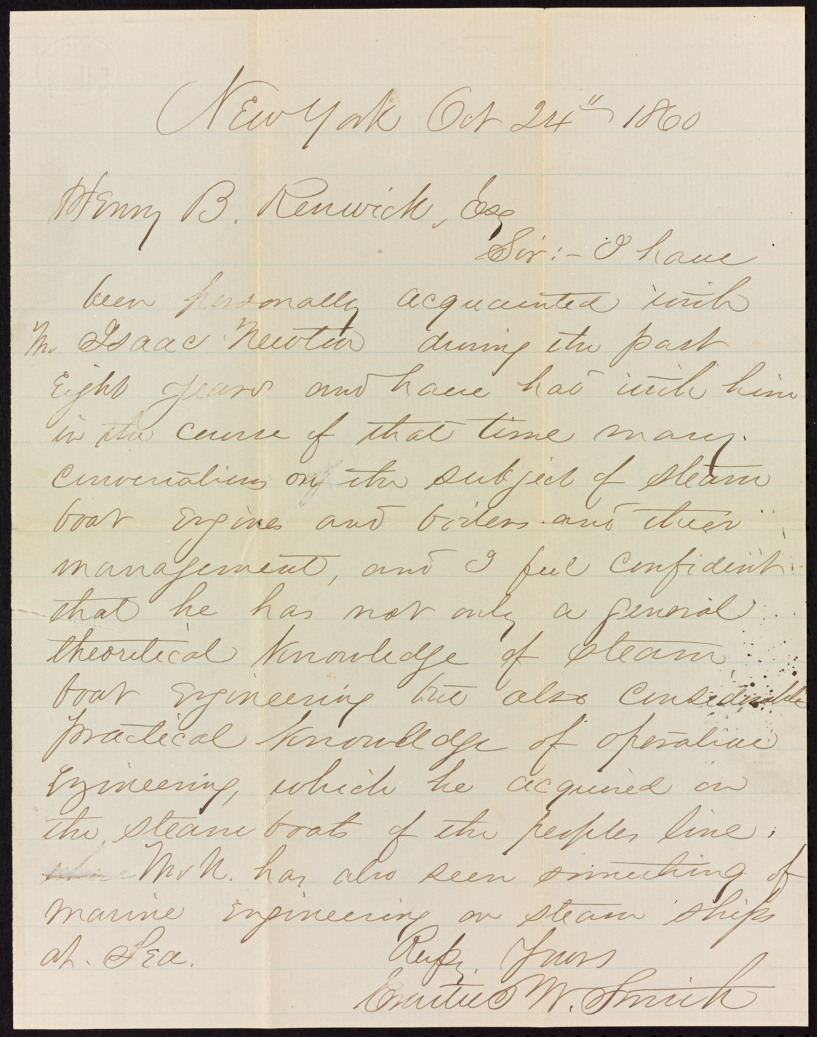 MS0013-2-3.10-1
 Full-size image
 E183.8.G3 W46 2001
 Full-size image
 Full-size image
 1957.0054.000001